
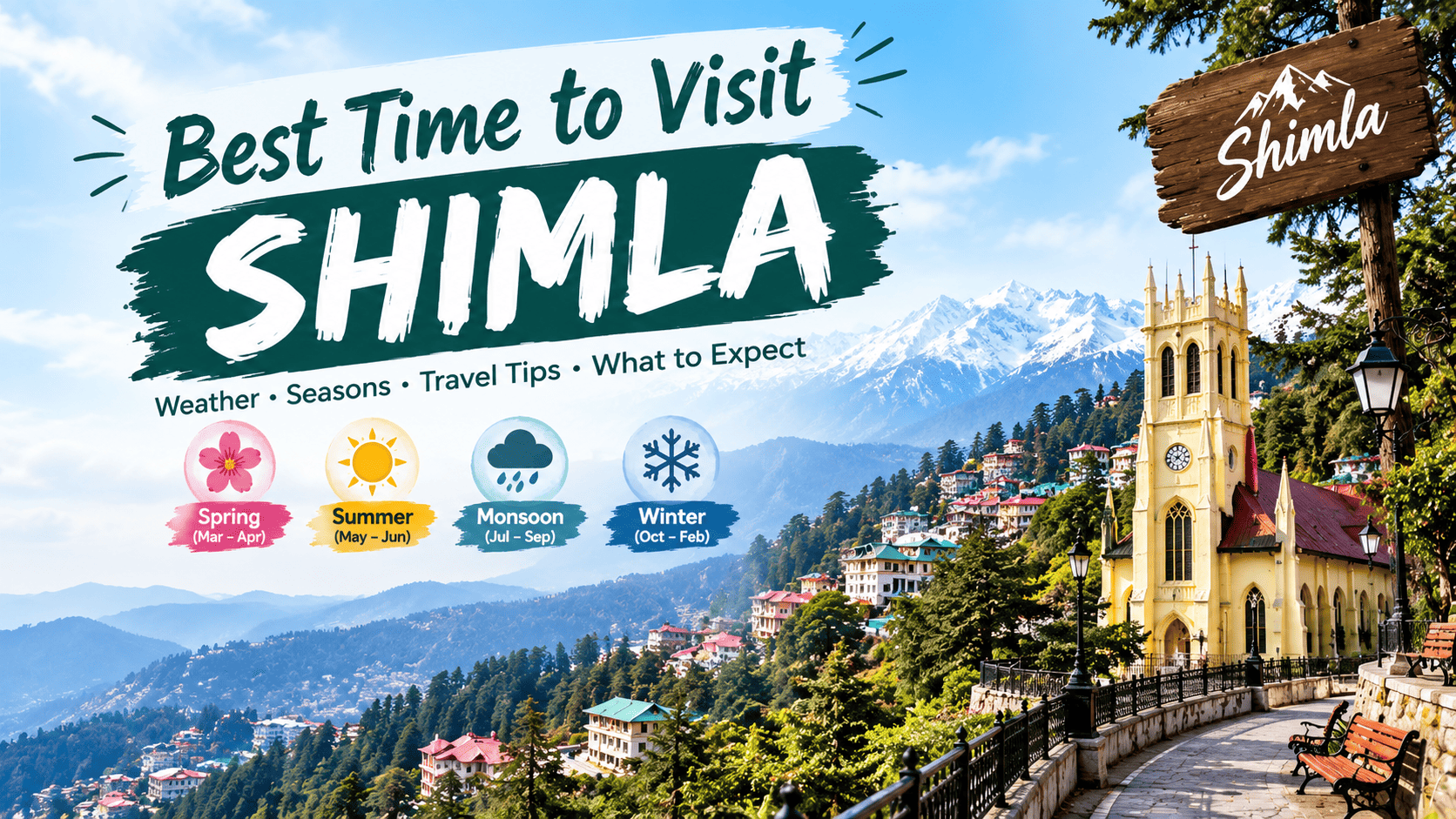
Quick Answer
The best time to visit Shimla is March to June for pleasant weather.
Daytime temperatures sit between 10°C and 29°C in this window.
If snow is your priority, mid-December to February is the best time to visit Shimla for snowfall.
One thing to know before you book: December 2025 recorded just 0.1 mm of rain. That was the sixth-lowest December total since 1901, per the Meteorological Centre Shimla.
If snow matters most, the second and third week of January has historically been the more reliable window — not Christmas.
Shimla Weather at a Glance: What Sets the Best Time to Visit Shimla
Shimla sits at 2,206 metres in the Himalayan foothills.
That altitude is exactly why Shimla weather stays cooler than most of North India, and why the best time to go Shimla depends so heavily on the month you pick.
Here’s the annual pattern before we break it down further:
- Warmest month: June, with daytime highs of 29°C and nights around 18-20°C
- Coldest month: January, with daytime highs of just 14°C and nights dropping to 1°C, occasionally lower during a cold spell
- Wettest month: July, averaging 357 mm of rain across 15 rainy days
- Driest month: November, averaging just 20 mm of rain over a single rainy day
- Annual rainfall: around 1,553 mm
- Most comfortable months overall: April, May, October, and November
That’s the framework. Now let’s get specific about the best time to visit Shimla for your particular trip.
Best Time to Visit Shimla — By What You’re Actually Looking For
There isn’t one single best time to visit Shimla.
There’s a best time depending on what you actually want from the trip. We run this route constantly, and here’s how we’d genuinely advise you.
Best Time to Visit Shimla for Pleasant Weather: March to June
This is the best season to visit Shimla for comfortable sightseeing.
March and April sit at 10-20°C, with the occasional spring thundershower. May and June climb to 16-28°C, and May is the sunniest month of the year at roughly 10 hours of sunshine a day.
The catch: this is also Shimla peak season, especially mid-May through June.
Delhi-NCR, Punjab, and UP families all head to the hills at once during this window. Book your hotel at least 3-4 weeks ahead if you’re travelling in this period.
Best Time to Visit Shimla for Snowfall: Late December to February
If you’re looking for the best time to visit Shimla for snowfall, the honest answer is: nobody can guarantee an exact date.
Any package promising guaranteed snow is overselling. Here’s what we can tell you based on how recent winters have actually played out:
- Shimla town’s first snowfall typically arrives between 10 and 20 December
- The second and third week of January is statistically the strongest window for heavy, sustained snow
- Kufri, Fagu, and Narkanda — all higher than Shimla town — get snow earlier and more reliably
We’ll unpack exactly what’s happened in recent seasons in the next section, because the pattern has genuinely shifted.
Best Time to Visit Shimla on a Budget: July to September (With a Caveat)
Monsoon is off-season in Shimla. Hotel rates drop and the town empties out.
But this is also the rainy season in Shimla — 357 mm of rain in July alone. The NH5 stretch between Kalka and Shimla is prone to landslides and waterlogging after heavy spells.
We don’t recommend a monsoon trip if you’re driving yourself, or if your itinerary is tight on days. A single landslide closure can cost you 4-6 hours.
Best Time to Visit Shimla for a Quiet Trip: October and November
This is the window most repeat travellers discover for themselves, and few first-time blogs mention it.
October brings 10-18°C days and clear skies once the monsoon clears out. November is the driest month of the year, at just 20 mm of rain.
You get comfortable weather, thin crowds, and hotel rates well below peak season — without the winter cold or the snow-chasing gamble.
Shimla Weather Month by Month: Best Time to Visit Shimla by Date
This table is the fastest way to check the best time to visit Shimla for your exact travel dates.
| Month | Day Temp | Night Temp | What to Expect |
|---|---|---|---|
| January | 14°C | 1°C (can fall to -7°C in a cold spell) | Coldest month; highest statistical snow probability, especially weeks 2-3 |
| February | ~15-16°C | Near freezing | Still cold; snow possible, tapering off |
| March | 10-20°C | Cool | Spring transition; occasional thunder and showers |
| April | 10-20°C | Mild | Pleasant, low rain, good sightseeing weather |
| May | 16-28°C | Mild | Sunniest month; peak season starts |
| June | Up to 29°C | 18-20°C | Warmest month; peak season |
| July | ~23°C | Humid | Wettest month; monsoon |
| August | ~22°C | Humid | Monsoon continues; least comfortable month |
| September | ~22-26°C | 12-17°C | Monsoon tapering; still rain-prone early on |
| October | 10-18°C | 5-10°C | Cool, dry, clear skies — one of the best months |
| November | 10-17°C | Cold | Driest month of the year |
| December | 2-12°C | Near freezing by month-end | Winter begins; first snowfall window (10th-20th typically) |
A note on Shimla weather right now: these are seasonal averages, not a live forecast.
Closer to your dates, the IMD’s regional forecast for Himachal Pradesh is more reliable than any blog for a 5-7 day window.
Snowfall in Shimla: What’s Actually Been Happening
This is the section most Shimla blogs get lazy on. Searches for “expected snowfall in Shimla” and “snowfall prediction in Shimla” deserve a real answer, not a repeated stock phrase.
The Historical Snowfall Pattern
Shimla’s snow season runs roughly mid-December to late February. The second and third weeks of January carry the best odds of a heavy, multi-day accumulation.
In the 2022-23 season, back-to-back Western Disturbances through the first three weeks of January produced one of the heaviest spells in over a decade. Kufri recorded over 4 feet of total snowpack at its peak, and roads closed for extended stretches.
What’s Changed in Recent Winters
Snowfall in Shimla town has become noticeably less reliable.
The Meteorological Centre Shimla recorded just 0.1 mm of precipitation in December 2025 — the sixth-lowest December total since 1901. January 2026 continued the pattern, with only 2.7 mm of rain by 13 January, roughly 89% below normal.
The IMD did forecast a real spell of widespread precipitation and isolated heavy snow for 22-24 January 2026. That’s a useful example of how these events actually arrive: as a specific 2-3 day window flagged 5-7 days out, not a season-long guarantee.
There have also been stretches of three consecutive years with no snowfall at all in Shimla town during December and March, per the Meteorological Centre Shimla’s own data. December and March, once treated as reliable bookend snow months, have been hit hardest.
What This Means for the Best Time to Visit Shimla for Snow
Don’t book a Christmas-specific “guaranteed snowfall” package.
Christmas week snow is possible but far from certain. Some years it doesn’t arrive until after 25 December; in others, it doesn’t arrive at all.
If snow is genuinely your top priority, weight your dates toward the second half of January.
Even without fresh snowfall during your visit, a December-February trip usually still has residual snow on higher slopes around Kufri. The cold, the pine forests, and the mountain atmosphere hold up well even between snow events.
Central Shimla can get rain while Kufri, Fagu, and Narkanda get proper snow at the same time. If snow is the goal, build in a half-day trip to one of these regardless of what Shimla town is doing.
Shimla Peak Season and Crowd Patterns
Shimla peak season runs in two windows: mid-May to June, and mid-December to early January.
Hotel prices can double, sometimes triple, during these stretches. Popular mid-range and luxury properties sell out weeks in advance around Christmas and New Year specifically.
If you can travel in April, early May, or late September through November, you get most of the peak-season charm. You skip the price surge and the Mall Road crowds.
Budget / Cost Breakdown for a Shimla Trip
Here’s a realistic, itemised budget for a family of four on a 4-day, 3-night mid-range trip from Delhi.
Costs shift with season. Expect the top end during peak weeks, and possibly higher during Christmas and New Year.
Shimla Trip Cost Table
| Expense | Budget Range | Notes |
|---|---|---|
| Round-trip transport (SUV, Delhi-Shimla-Delhi) | ₹11,000 – ₹14,000 | All-inclusive cab fare; toll (₹390-630 each way) usually extra |
| Accommodation (3 nights, mid-range hotel) | ₹7,500 – ₹18,000 | ₹2,500-6,000/night; luxury heritage properties go above ₹15,000/night in peak season |
| Food (4 people, 4 days) | ₹6,400 – ₹11,200 | ₹400-700 per person per day at local dhabas and mid-range restaurants |
| Local sightseeing taxi (per day) | ₹1,500 – ₹2,500 | Needed separately for Kufri, Chail, or Naldehra |
| Kalka-Shimla toy train (optional, per person one-way) | ₹65 – ₹595 | ₹65 second sitting; up to ₹595 for first class on the Shivalik Deluxe |
| Estimated total (4D/3N, family of 4) | ₹35,000 – ₹48,000 | Excludes shopping, activities, and Kufri/Chail add-on stays |
What Actually Moves the Number
The accommodation line moves the most.
A basic double room near Mall Road can go from ₹800 in the off-season to ₹3,000+ during Christmas week for the exact same property.
Shift your trip a week outside the Christmas-New Year block, and you can cut your hotel spend by half.
How to Reach Shimla
Shimla is roughly 340-350 km from Delhi. You have three practical ways in.
By Road
A private cab takes 7-9 hours via Karnal, Ambala, Chandigarh, and Kalka.
Sedan fares start around ₹4,500-6,500 one-way. SUVs run ₹6,500-14,000 depending on one-way or round trip.
Toll for a car is about ₹390 each way, ₹630 for an SUV. An overnight HRTC Volvo from ISBT Kashmiri Gate costs ₹700-1,200 and takes 9-10 hours.
By Rail + Toy Train
Take the Shatabdi Express or Kalka Mail from New Delhi to Kalka — roughly 4-5 hours.
Then switch to the UNESCO-listed Kalka-Shimla toy train for the 96 km climb, which takes 5-6 hours through 102 tunnels and over 800 bridges.
Fares range from ₹65 (second sitting) to ₹595 (Shivalik Deluxe first class). This is the slowest option, but genuinely the most scenic.
By Air
The nearest airport is Jubbarhatti, about 22 km from Shimla.
Flights from Delhi run ₹3,000-7,000. Factor in airport reporting time and the road transfer — it doesn’t save as much time as it looks on paper.
Flight schedules on this route also change more often than road or rail. Confirm directly with the airline before locking in other bookings.
A friction point most people miss: central Shimla has restricted vehicle movement around Mall Road. Your cab will drop you at a parking point below, and you’ll walk or take a lift up from there.
Where to Stay in Shimla
Budget (₹800 – ₹3,000/night)
Guesthouses and budget hotels cluster around Mall Road and the lower bazaar.
Expect basic rooms, but most now include hot water and heating.
Mid-Range (₹2,500 – ₹6,000/night)
This is the largest category. Expect reliable heating, breakfast included, and locations closer to the Ridge.
Luxury (₹15,000+/night in peak season)
Heritage properties and resorts, some set slightly outside the town centre in areas like Kufri, trading a short commute for quiet and views.
Where to base yourself: stay near Mall Road or the Ridge if you want to walk to restaurants in the evening. Stay in Kufri if snow activities are your priority.
What to Eat in Shimla
Don’t limit yourself to the usual North Indian menu on Mall Road. Shimla’s local Himachali food is worth actively seeking out.
- Sidu — steamed wheat bread, usually served with ghee and a lentil or meat curry
- Chana Madra — chickpeas in a yoghurt-based curry, a signature Himachali Pahari dish
- Trout — fresh trout from the Kufri and Kullu region, often grilled or pan-fried
- Momos and thukpa — Shimla has a strong Tibetan food presence near the Ridge and lower bazaar
- Café options on Mall Road — continental and Indian food with a view
Budget travellers can expect ₹400-700 per person per day at local dhabas. Mid-range dining runs higher, especially directly on Mall Road.
Sample Itinerary: 4 Days, 3 Nights in Shimla
Day 1 — Arrival and Mall Road
Arrive by cab, train, or flight. Check in and rest.
Spend the evening walking the Ridge and Mall Road. Visit Christ Church as the light fades.
Day 2 — Heritage Shimla
Morning: a heritage walk covering the Viceregal Lodge and colonial-era buildings.
Afternoon: Jakhu Temple and the hilltop Hanuman statue — go early for fewer crowds. Evening: shopping for Himachali wool in the lower bazaar.
Day 3 — Kufri Day Trip
Full day at Kufri, 13 km away.
Visit Kufri snow activities and Himalayan Nature Park. If there’s snow on the ground, try the activity zone near Mahasu Peak.
Day 4 — Toy Train Experience and Departure
If you arrived by road, take a short round trip on the toy train to Barog or Solan before heading back.
If you arrived by train, use the morning for last-minute Mall Road shopping.
For a longer trip: add Chail (2-3 hours away, home to the world’s highest cricket ground) or Naldehra (known for its golf course) as a day trip extension.
Safety and Practical Considerations
Monsoon Driving (July-September)
Landslides and waterlogging are a real risk on NH5 between Kalka and Shimla. Build in buffer time and avoid driving after dark on hill sections during heavy rain.
Winter Driving (December-February)
Roads to Kufri and Narkanda can close temporarily after heavy snowfall. Carry warm layers even for a day trip, in case you’re delayed.
Altitude and Cold
Shimla (2,206 m) doesn’t cause altitude sickness for most travellers. But the day-night temperature swing is sharp, especially October through February — layer up rather than relying on one heavy jacket.
No Special Permits Needed
Unlike destinations further into Himachal, such as Spiti or parts of Kinnaur, Shimla requires no Inner Line Permit for Indian nationals. Don’t pay extra for “permit processing” on a standard Shimla trip.
Mistakes to Avoid
- Booking a Christmas trip purely for guaranteed snow. December 2025 passed with almost no precipitation. Weight your dates toward mid-to-late January instead if snow matters most.
- Assuming one hotel location works for both sightseeing and snow. Mall Road suits walking and shopping; Kufri suits snow activities.
- Driving yourself through the hills at night, especially during monsoon or winter.
- Underestimating the Delhi-Kalka-Shimla connection buffer. A 20-30 minute delay on the main line can mean missing your toy train slot.
- Paying for “permit assistance” for a standard Shimla trip. No special permit applies to Shimla itself.
FAQs
Q: What is the best time to visit Shimla? A: March to June for pleasant weather, or mid-December to February for a chance at snow. October and November offer the best mix of mild weather and fewer crowds.
Q: What is the best month to visit Shimla? A: May for weather and sunshine, or January for the strongest snow odds — depending on what you’re travelling for.
Q: Is it snowing in Shimla right now? A: This depends on the season and specific week. Shimla’s snow window runs mid-December to February, with the second and third week of January historically the strongest bet. Outside that window, Shimla does not get snowfall.
Q: What is the expected snowfall in Shimla this year? A: Snowfall can’t be reliably predicted more than 5-7 days out. The 2025-26 season was unusually dry through December and early January, with a confirmed IMD-forecast spell around 22-24 January 2026.
Q: Which month has the most snowfall in Shimla? A: Statistically, the second and third week of January has produced the heaviest, most sustained snowfall in recent years — more reliably than December.
Q: What is the temperature in Shimla in January end? A: Late January typically sees daytime highs around 14°C and nighttime lows near or below freezing, down to -7°C during a cold spell.
Q: What is the rainy season in Shimla? A: July through September, with July the wettest month at roughly 357 mm of rain across 15 rainy days.
Q: Is Shimla good to visit with family in summer? A: Yes. April through June offers 10-29°C weather. May-June is also peak season, so book hotels 3-4 weeks ahead.
Q: Do I need a permit to visit Shimla? A: No. Shimla requires no Inner Line Permit for Indian nationals. Permit requirements apply further into Himachal Pradesh, such as parts of Kinnaur and Spiti.